Half our recent news is about Kalshi, Polymarket and the CFTC. Here is what an event contract actually is, and why regulators disagree about it.
If you have read our news lately, you have seen Kalshi, Polymarket, the CFTC and a run of national regulators. This page explains what the argument is about.
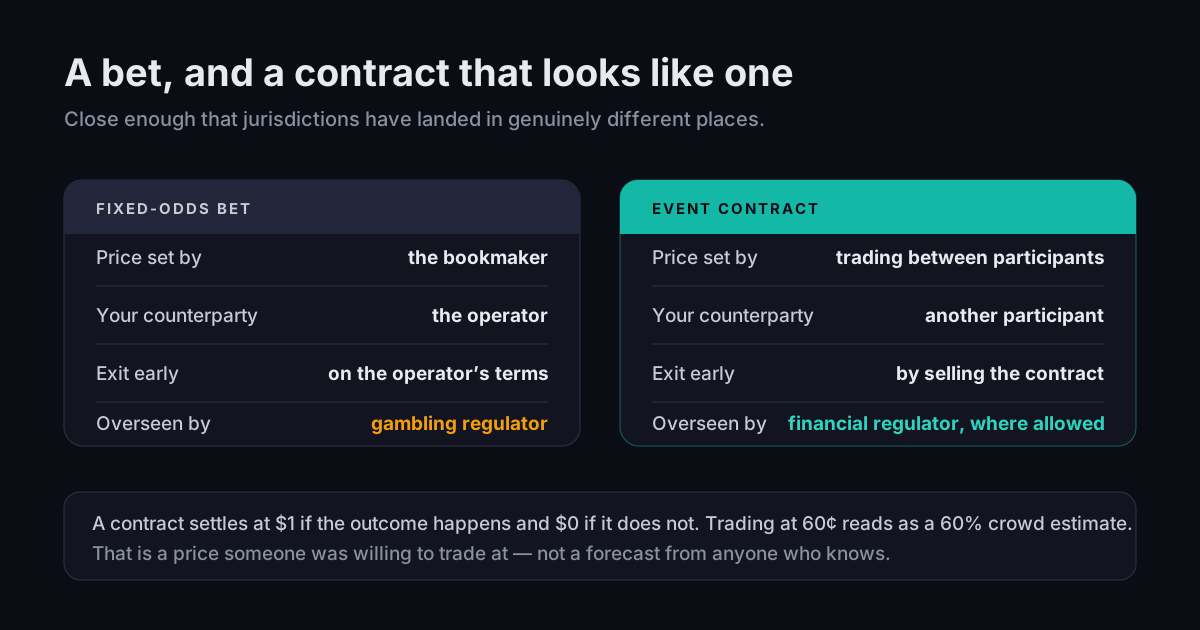
A prediction market lets people trade contracts that pay out a fixed amount if something happens and nothing if it does not. A contract on an outcome might trade at 60 cents; if the outcome occurs it settles at one dollar, and if it does not it settles at zero. The price moves as people buy and sell, so it reads as a running estimate of how likely the crowd thinks the outcome is.
| Fixed-odds bet | Event contract | |
|---|---|---|
| Who sets the price | The bookmaker | Trading between participants |
| Your counterparty | The operator | Another participant |
| Can you exit early | Sometimes, on the operator's terms | Yes, by selling the contract |
| Who regulates it | Gambling regulator | Financial regulator, where it is allowed |
That last row is the whole dispute. The mechanics sit close enough to both categories that jurisdictions have landed in genuinely different places.
In the United States these contracts are treated as derivatives and overseen by the Commodity Futures Trading Commission, which has been writing rules for sports event contracts through 2026. Several states argue the sports versions are simply betting, and the resulting cases have been running through the appellate courts.
In Europe the direction has been the opposite. France ordered its internet providers to block Polymarket, the Czech Republic added it to a list of unauthorised games, Spain's regulator blocked platforms while it opened proceedings, and nine European regulators announced coordinated action against unlicensed platforms. Meanwhile Gibraltar published a dedicated framework and licensed operators under it.
So the same product is a financial instrument in one place, illegal gambling in another, and a newly licensed category in a third.
Two reasons, and it is worth being straight about both.
The first is that the two worlds are converging commercially. Sportsbook operators have launched or acquired prediction market businesses, sports data suppliers now serve both, and leagues have signed with prediction market platforms.
The second is narrower: crypto gambling coverage in 2026 is dominated by this story. When we filled our news section with recent articles, prediction markets made up more than half of what was published in the category. We chose to include them rather than reach back years for a thinner set of crypto-casino-only stories.
We do not rate prediction market platforms. They are not in our casino directory, they carry no Trust Score, and nothing here should be read as a view on whether to use one.
Also worth knowing: insider trading cases have been a running theme in this sector's news — charges involving non-public information have already been brought. That risk belongs to the participants, not to the platform's licence status.
A price on a prediction market is not a forecast from an expert. It is the price at which someone was willing to trade, which is a different thing, and it can be moved by anyone with enough money and a reason.
Looking for a trusted casino?
Browse our verified crypto casino directory with trust scores and player reviews.
Had an issue with a casino?
Submit a Dispute